Freetide Research / 2026-09-16

The Missed-Call Economy: What Slow Response Costs Australian Trade Businesses

Caydin Cezar10 min read
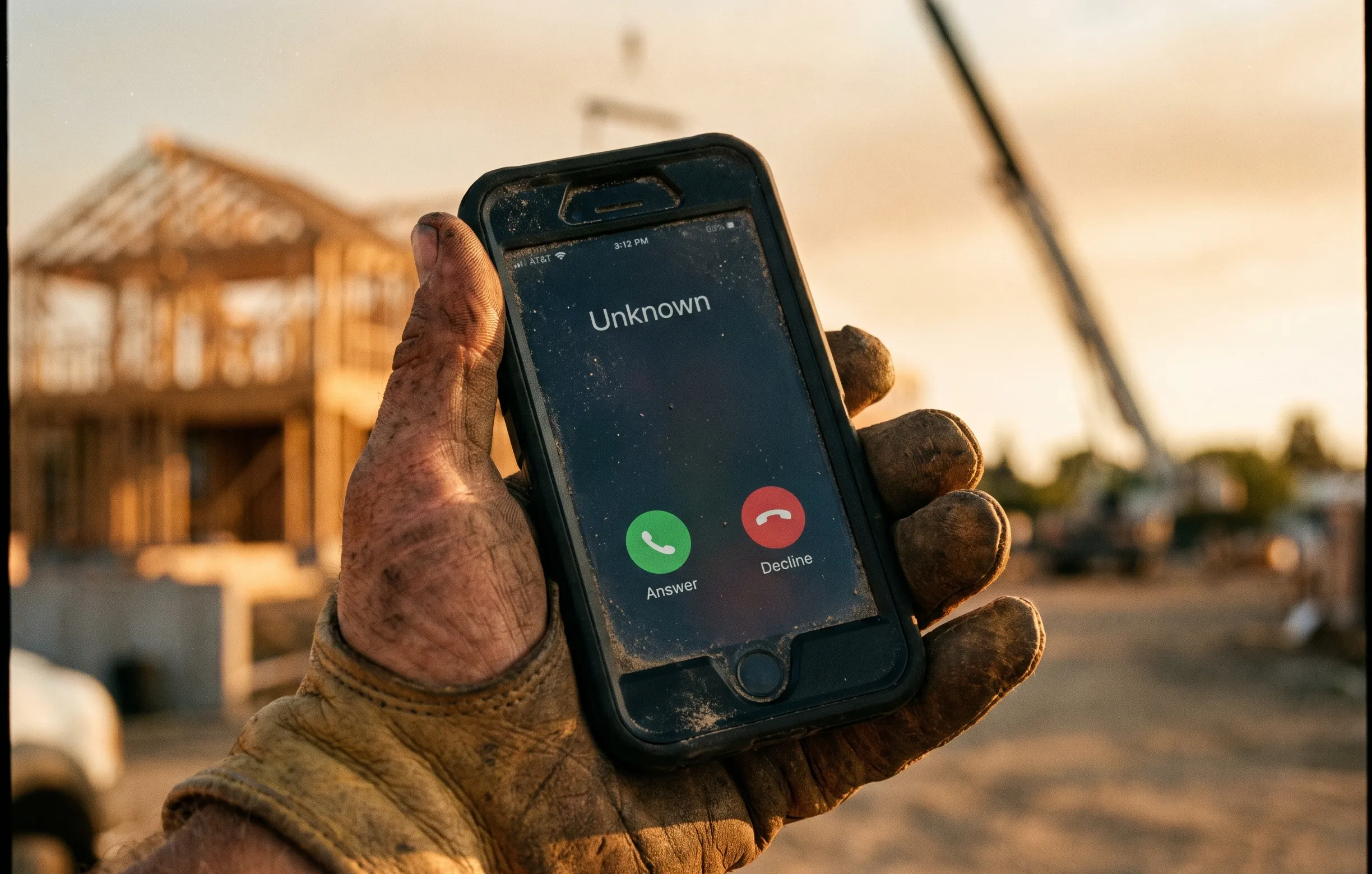
A tradie's phone ringing on a work site — the missed call an Australian trade business can't afford

Short answer

Australia has ~2.8 million businesses, and most trade operators are one- or two-person outfits who live and die on the phone. The public data shows most inbound calls to small businesses go unanswered, and the customer who can't reach you calls a competitor. On conservative, clearly-labelled assumptions, missed calls plausibly cost a typical one-van trade business somewhere around $20,000 a year in lost work.

Contents

Australia's trades are a nation of sole operators

Australia had 2,814,778 actively trading businesses at 30 June 2026, and only about 35% of them employ anyone. The other two-thirds are non-employing — a single person, a ute, and a phone. Small businesses under 20 staff make up 97% of every business in the country.

The trades sit right at the sharp end of that. Australia's construction industry is roughly 431,000 businesses and a $641 billion division, but 59% of construction businesses have no employees at all, and 98.5% are small businesses. The people doing the actual work — 'construction services', the electricians, plumbers, chippies and subbies — are 68% of a 1.29 million-strong construction workforce.

Put plainly: most Australian tradies are the business. When they're up a ladder or under a floor, there is nobody else to pick up the phone.

Plans and tools on a workbench representing a small Australian trade business
Most Australian trade businesses are one or two people — the owner is the receptionist too.

Most calls to a small business are never answered

A phone call is still how a customer with a burst pipe or a dead switchboard reaches a tradie. The problem is that a one-person business physically cannot answer while working — and the data on what happens next is brutal.

One US study of 85 small businesses monitored their calls for 30 days and found only 37.8% were answered; the rest went to voicemail or got no response at all — roughly 6 in 10 calls unattended. It's a small sample, so treat the exact number as illustrative rather than an Australian measurement. But the direction is not in doubt, and what follows the missed call is the real damage: fewer than 3% of callers sent to voicemail leave a message, and around 85% of people who can't get through simply won't call back. They call the next tradie on Google.

That's the mechanic of the missed-call economy: the work doesn't disappear, it just goes to whoever picked up.

Speed is the whole game

Even when a business does eventually respond, slow almost always loses. Analysis of millions of inbound leads found only a tiny fraction — around 0.1% — were engaged within five minutes, while more than half weren't contacted for over a week. The businesses that reply first win: roughly 78% of customers buy from whoever responds to their enquiry first, and contact inside five minutes converts many times better than a reply an hour later.

These are US and global figures — again, illustrative rather than Australian — but they line up with the oldest finding in the field: Harvard Business Review's research on online sales leads concluded, back in 2011, that most companies respond far too slowly to convert the interest they've already paid to create.

For a tradie, 'respond first' and 'answer the phone' are the same sentence.

The work doesn't disappear when you miss a call. It just goes to whoever picked up.

What a single missed call is actually worth

The reason this matters in dollars is that a trade job isn't a low-value transaction. An Australian electrician typically charges an $80–$130 call-out fee plus $80–$100 an hour; a plumber charges $80–$200 an hour, and an after-hours emergency can run $300–$700 in a single visit. A booked job is routinely worth a few hundred dollars, and often much more.

It's worse than just the job, too. In home services the cost to generate a single lead often exceeds $100 in advertising — so a missed call also burns the marketing money already spent to make the phone ring in the first place. You pay to create the lead, then hand it to a competitor for free.

The missed-call cost: an estimate

So what does it add up to across a year? There is no published Australian figure for this, so we built a transparent estimate. One input is anchored in Australian data — what a trade job is worth (hipages pricing above). The rest are honest assumptions, shown as a low/mid/high range so you can see exactly what drives the number: how many genuinely-missed new-customer calls a week (the missed-call studies above are why even a low number is realistic), and how many of those would convert if you'd answered first.

On the middle column — three missed new-customer calls a week, a conservative 50% close rate if you'd answered first, and a $300 average job — a typical one-van trade business is losing on the order of $20,000 a year in work it never even knew rang. This is an estimate, not a measured statistic; the point is that even cautious assumptions produce a number no small operator can shrug off.

InputLowMidHighBasis
Genuinely-missed new-customer calls / week235Assumption
Close rate if you'd answered first40%50%60%Assumption (cf. 78% buy from first responder)
Average booked job value$220$300$400hipages AU pricing
Working weeks / year484848
Estimated work lost / year≈ $8,400≈ $21,600≈ $57,600Calculated
Illustrative estimate. Cited input: average job value (hipages AU pricing). Call volume and conversion are labelled assumptions shown as a range — the missed-call studies above are why the assumed volumes stay conservative. Adjust any input and the output moves with you.

How the fast operators are pulling ahead

The tradies who fix this don't hire a receptionist — most can't justify one. They automate the catch: a missed call becomes an instant text conversation that answers, qualifies the job and books it, day or night, so the enquiry never reaches the next business on the list.

The wider small-business data is moving the same way. MYOB's Business Monitor found Australian SMEs using AI are growing 2.8 times faster than those that aren't, and about 40% of SMEs are now adopting it — while 46% still say they have no plans to. That's a correlation, not proof missed calls explain the gap; but responding instantly, every time, is one of the concrete things separating the fast operators from the rest.
See how an AI receptionist catches a missed call

Sources

  1. Australian Bureau of Statistics — Counts of Australian Businesses

    At 30 June 2026 there were 2,814,778 actively trading businesses in Australia; only 35.4% employ anyone — roughly two-thirds are non-employing sole operators.

    abs.gov.au/statistics/economy/business-indicators/counts-australian…
  2. ASBFEO (citing ABS)

    Small businesses (under 20 employees) are 97% of all actively trading businesses — about 2.74 million firms.

    asbfeo.gov.au/small-business-data-portal/number-small-businesses-au…
  3. IBISWorld — Construction (Australia)

    There are about 431,000 businesses in Australia's Construction industry, a division worth $641.1 billion in 2026.

    ibisworld.com/australia/industry/construction/306
  4. Australian Bureau of Statistics — The nuts and bolts of the Australian Construction industry

    'Construction services' — the trades and subcontractors — make up 68.4% of a construction workforce of about 1.29 million people (2023-24).

    abs.gov.au/articles/nuts-and-bolts-australian-construction-industry
  5. Master Builders Australia (citing ABS)

    59.1% of construction businesses have no employees at all, and 98.5% of the sector are small businesses (under 20 staff).

    masterbuilders.com.au/facts-stats-on-how-building-supports-the-econ…
  6. Jobs and Skills Australia — Construction industry profile

    Around 1,371,500 Australians work in construction — about 9.3% of all workers.

    jobsandskills.gov.au/data/occupation-and-industry-profiles/industri…
  7. 411 Locals

    A 30-day study of 85 small businesses across 58 industries found only 37.8% of calls answered — about 6 in 10 (62%) calls to small businesses went unattended. (US study, small sample — illustrative.)

    411locals.us/small-business-owners-dont-answer-62-of-phone-calls
  8. Hicira — Missed Call Statistics

    Fewer than 3% of callers sent to voicemail leave a message, and about 85% of people who can't reach a business won't call back — they call a competitor. (US aggregate — illustrative.)

    hicira.com/missed-call-statistics
  9. InsideSales — Lead Response Research

    Across 5.7 million inbound leads, only 0.1% were engaged within 5 minutes and 57.1% were first contacted only after more than a week. (US B2B dataset — illustrative.)

    insidesales.com/response-time-matters
  10. InsideSales — Lead Response Research

    Contacting a new lead within 5 minutes converts roughly 8x better than waiting even an hour. (US B2B — illustrative.)

    insidesales.com/response-time-matters
  11. Vendasta — Lead Response Time

    78% of customers buy from the business that responds to their enquiry first. (US/global vendor summary — illustrative.)

    vendasta.com/blog/lead-response-time
  12. Harvard Business Review — The Short Life of Online Sales Leads

    Foundational research on online sales leads found most companies respond to enquiries far too slowly to convert them. (US/global, 2011.)

    hbr.org/2011/03/the-short-life-of-online-sales-leads
  13. hipages — electrician cost guide

    Australian electricians typically charge an $80–$130 call-out fee plus $80–$100 per hour.

    hipages.com.au/article/how_much_does_an_electrician_cost
  14. hipages — plumber cost guide

    Australian plumbers charge $80–$200 per hour with $60–$250 call-out fees; after-hours emergency visits can run $300–$700.

    hipages.com.au/article/how_much_does_a_plumber_cost
  15. Invoca — Home Services Marketing Statistics

    In home services, cost-per-lead often exceeds $100 — so a missed call also wastes the marketing spend already paid to generate it. (US data — illustrative.)

    invoca.com/blog/home-services-marketing-stats
  16. MYOB — Business Monitor

    Australian SMEs using AI are growing 2.8x faster than those that aren't, and about 40% of SMEs are now adopting AI.

    myob.com/au/press-releases/ai-powered-small-businesses-are-growing-…
  17. MYOB — Business Monitor

    46% of Australian SMEs say they are not using AI and have no plans to over the next 12 months.

    myob.com/au/press-releases/ai-powered-small-businesses-are-growing-…
  18. Salesforce — State of the Connected Customer

    80% of customers say the experience a company provides matters as much as its products and services. (US/global — illustrative.)

    salesforce.com/small-business/what-are-customer-expectations
  19. Nextiva — Gen Z customer service study

    Even among Gen Z, 77% have used a phone call to reach support and 72% would choose it again — the phone is still a primary channel. (US survey — illustrative.)

    nextiva.com/blog/gen-z-embraces-phone-support.html

Written by

Caydin Cezar

Caydin Cezar

Caydin builds Freetide's demand, intake, and reputation systems for Australian trade businesses.

Built in Melbourne

Read about Freetide

FAQ

Common questions

How was the annual missed-call cost estimated?

Annual work lost = missed new-customer calls per week × close rate if answered first × average job value × working weeks. One input is cited from Australian data (average job value, from hipages pricing); the missed-call and speed-to-lead studies are illustrative context, not precise Australian inputs. Call volume and close rate are labelled assumptions shown as a low/mid/high range. The mid case (3 missed calls/week, 50% close, $300 job, 48 weeks) is about $21,600 a year. It is an estimate, not a measured figure.

Are these numbers Australian?

The market-size, business-count and AI-adoption figures are Australian primary sources (ABS, ASBFEO, IBISWorld, Jobs and Skills Australia, MYOB). The call-answer-rate and speed-to-lead figures are US and global studies, labelled as illustrative — the direction is well-established, but they are not Australian measurements.

Why do so many trade businesses miss calls?

Because most of them are one or two people. In Australian construction, 59% of businesses have no employees at all. The owner is on the tools, so there is no one else to answer — and voicemail rarely works, since fewer than 3% of callers leave a message and most simply call a competitor.

Can I reuse these statistics?

Yes. This page is published by Freetide AI for journalists, researchers and trade-business owners. Please cite the original primary source (linked in the Sources list) for any third-party statistic, and credit Freetide AI for the missed-call cost estimate.

Start here

Stop handing missed calls to your competitors.

The free audit checks where leads are slipping away — missed calls, slow replies, weak reviews — and shows what an AI receptionist would catch.

Book a free audit