What "AI for tradies" actually means
Forget robots on the job site. For a trade business, AI just means software that can read a message, work out what the person wants, and respond like a competent office admin would — instantly, at any hour, without you touching your phone.
That is the whole trick. A customer texts "hot water's gone, can someone come today?" and the AI reads it, replies, asks the right questions, works out how urgent it is, and hands you a ready-to-quote summary — while you are up a ladder on another job. It is not intelligence for its own sake; it is admin and follow-up that never sleeps and never forgets.
Text-back, not a talking robot
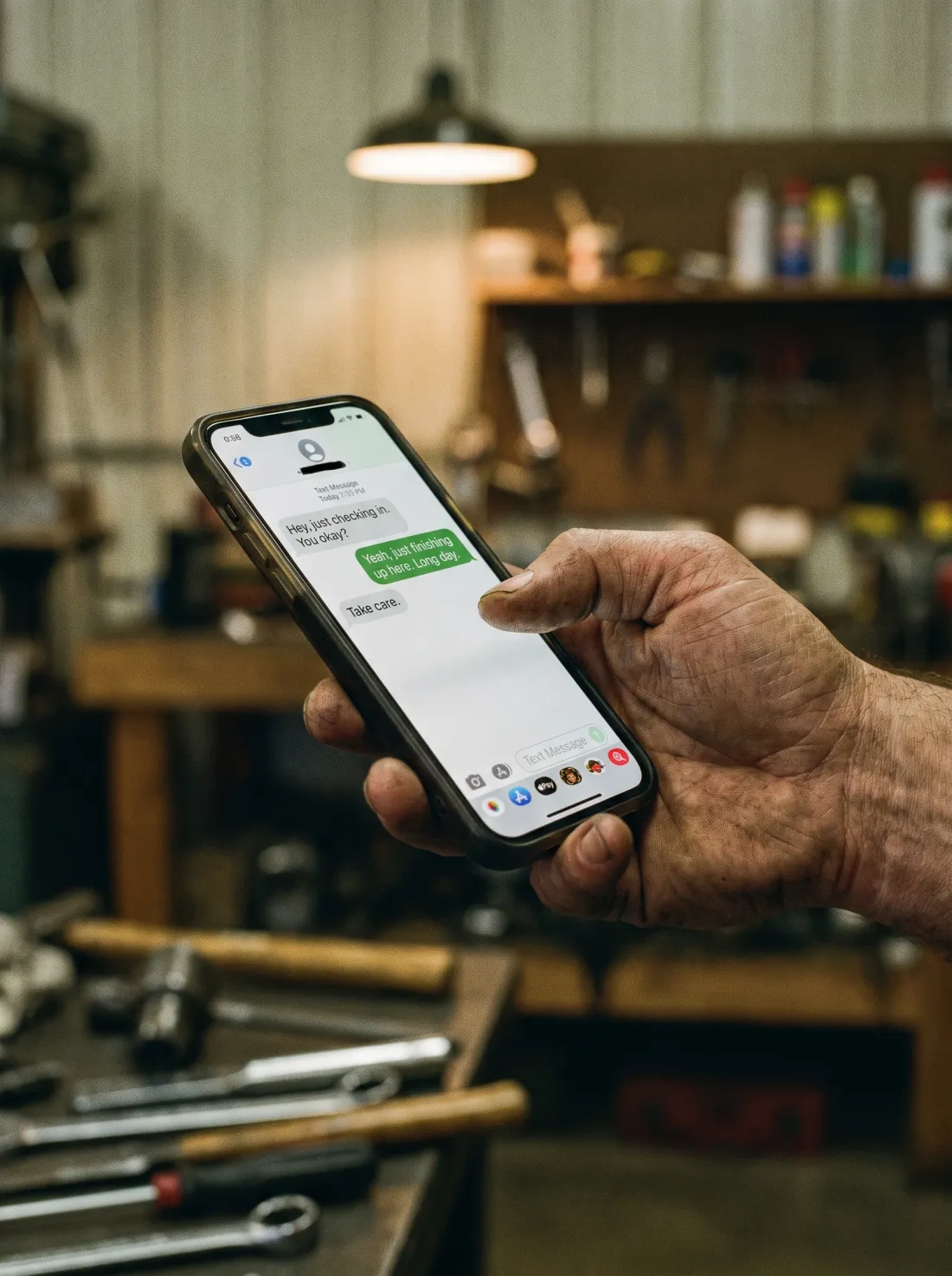
Freetide's system replies by SMS, not a synthetic voice picking up your phone. A missed call triggers a text message, the customer types back like they would to a mate, and the AI reads and replies in that same thread until you take over. No customer ever gets patched through to a computer voice — it's a conversation on the screen, not a call answered for you.
How many Australian tradies are actually using this
It's not a niche gimmick anymore. In 2024–25, around 12% of Australian businesses used AI at work, up from very low rates in 2021–22, with small and micro businesses sitting at roughly 11% uptake against 35% for large businesses. National Australia Bank research found 42% of Australian SMEs already use AI, with time saved for the business or family the most commonly reported benefit — which lines up with exactly what a trade business needs an office admin for.
Why the shift is happening now
Deloitte Access Economics found that although two-thirds of small and medium businesses already use AI, just 5% of those already using it are fully set up to get real value from it, and lifting adoption further could add $44 billion to the Australian economy. Translation: most small businesses have dabbled with a chatbot or two, but very few have anything properly wired into how they actually run — which is the gap a done-for-you system is built to close.
The jobs AI actually does for a trade business
AI for tradies handles the everyday jobs that leak leads: replying to new enquiries, following up quotes, booking work and asking for reviews.
- Missed-call text-back — a call you can't answer becomes an instant "Sorry we missed you, what's the job?" SMS, so the customer doesn't just ring the next tradie.
- 24/7 lead qualification — an AI asks the right questions by text, sorts a real job from a tyre-kicker, and captures the address, the urgency, and the detail.
- Review growth — every finished customer gets asked for a Google review at the right moment, and replies get drafted for you.
- Quote follow-up — the quote that went quiet gets a nudge instead of being forgotten.
- Admin — quoting, scheduling and invoicing help (a job some tools specialise in) sits alongside the lead work.
A worked example: the Friday-arvo burst hot water unit
Take a two-person plumbing outfit in Dandenong. It's 4:40pm on a Friday. Both blokes are under a house re-piping a bathroom and the phone rings out. Under the old way, the customer with a leaking hot water unit hangs up and rings the next plumber on the Google list. With text-back running, the missed call fires an SMS within seconds: "Sorry we missed you — what's the job and where are you?" The customer replies "hot water unit's leaking everywhere, need someone today, [address]". The AI asks two follow-up questions — is the water off at the mains, is it near any power points — flags the job as urgent, and texts the owner a clean summary. He calls back fifteen minutes later, once the fitting he was working on is done, not three hours after knock-off. That is the whole point: the customer never had to try anyone else.
What it deliberately doesn't do
It doesn't diagnose the fault, price the job, or replace your quote. It hands you a clean brief so the first real conversation with the customer starts from the job itself, not from "sorry, what did you need again".
AI tools for tradies vs a done-for-you AI system
Search "ai tools for tradies" or "ai admin tools for tradies" and you'll find dozens of apps. The catch is that a tool is something you still have to choose, wire up, and run yourself — on top of a full day on the tools. Most tradies buy one, use it for a fortnight, and let it lapse.
A done-for-you system is the opposite: it is built around your business, connected to your phone number and your Google profile, and run for you. You don't learn software — you just start getting better summaries and more reviews. That is the difference between an AI tool and an AI solution, and it is the gap Freetide is built to fill for Australian trades.
What "connected to your business" actually means
For Freetide that means the system sits on your existing business number and your existing Google Business Profile — you don't migrate your number, and customers keep texting the number they already have saved on old invoices and fridge magnets.
The privacy question to ask before you connect anything
If your business turns over more than $3 million a year, an AI tool that touches a customer's phone number, address or job details is handling personal information under the Privacy Act 1988. Most sole traders and small trade businesses sit under that threshold and are exempt, though the exemption falls away if you trade in personal information or provide a health service. The Office of the Australian Information Commissioner advises businesses to check where an AI tool stores data, prefer Australian-based storage, avoid feeding sensitive customer information into general-purpose AI tools, and use enterprise versions that come with a data processing agreement. Ask any AI vendor, Freetide included, exactly where your customer data lives and who can see it before you connect a single lead.
Voluntary standards you'll start hearing about
The Department of Industry, Science and Resources has published a Voluntary AI Safety Standard for Australian businesses adopting AI systems. It's not mandatory for a small trade business today, but it's a useful checklist — human oversight, transparency about what the AI decided and why, and a clear process if something goes wrong — for judging whether an AI provider actually knows what it's doing, versus one that's just bolted a chatbot onto a website.
Is AI worth it for a small Australian trade business?
Here is the honest maths. Most trade jobs are worth hundreds to thousands of dollars. If AI catches even one job a month that you would otherwise have lost to a missed call or a slow reply, it has more than paid for itself. The tradies who benefit most are the ones losing leads to a ringing-out phone, slow follow-up, or a thin trail of Google reviews.
It is a weaker fit if your only problem is that not enough enquiries come in at all — that is a demand and marketing problem first. Good AI won't invent customers; it makes sure you keep the ones who already tried to reach you.
The break-even math in plain terms
If a single missed call turns into one recovered job a month, and that job is worth even a few hundred dollars, most sensible monthly costs for a done-for-you system are covered by that one job alone — everything else the system catches that month is upside. The maths gets worse, not better, the busier you are, because a busy tradie is the one least likely to ever pick up a fourth call in a row.
Where it's the wrong tool for the job
If the phone simply isn't ringing much, no amount of text-back automation fixes that — you need more enquiries first, which is a lead generation and Google visibility problem, not an admin one.
What the national data says about who's adopting AI and why
National Australia Bank research found 42% of Australian SMEs already use AI, with time saved for the business or family the most commonly reported benefit — not cost-cutting, not chasing a trend. That matches what tradies actually tell us: the win isn't a flashy feature, it's getting an evening back.
How to choose an AI system for your trade business
Not every AI product built for tradies is built well. Before you connect anything to your business number or your Google profile, run it through a short, practical checklist rather than trusting a slick demo.
The goal isn't to find the cleverest AI — it's to find the one that quietly does the boring bit right, every single time, without you having to babysit it.
Questions to ask before you sign up
Ask exactly what happens on a missed call — does it text, or does it try to answer with a voice, because a robotic voice answering a distressed customer is a worse experience than no answer at all. Ask where the conversation data is stored and who can see it. Ask what happens if the AI gets a question wrong — does it hand straight to you, or does it guess. Ask whether you can read every conversation afterwards, in plain English, without digging through a dashboard built for a call centre manager.
Red flags that mean walk away
Be wary of any provider that wants you to port your business number away from your current carrier, that can't show you a real conversation transcript before you sign, or that talks about "AI voice agents" answering your calls live — that's a different product with a different failure mode, and it's not what most trade customers want when they're standing in a flooded laundry.
Trial it on real leads before you trust it fully
A fortnight is usually enough to tell if a system fits your trade. Watch what it captures on the first few missed calls, check whether the summaries it hands you actually match what the customer meant, and only then let it run unsupervised on every call that comes in.
How Freetide does AI for tradies
Freetide is a Melbourne AI-automation agency that builds a bespoke three-engine system for each trade business rather than handing you another app. Set up once, run for you monthly.
The Intake Engine — text-back for missed calls, 24/7
Answers missed calls with an instant SMS, qualifies the lead by text with the right questions for your trade, and hands you a ready-to-act summary — day, night, or job-site-with-no-signal.
The Demand Engine — getting found on Google
Works on the side of the problem AI can't fix on its own: whether enough people find your business on Google in the first place. Pairs with intake so the extra enquiries it generates don't get lost the same way old ones were.
The Reputation Engine — reviews, done properly
Asks every finished customer for a Google review at the right moment and drafts replies for you to approve. We don't write fake reviews, don't offer discounts in exchange for a review, and don't gate which customers get asked — that kind of activity draws regulatory attention in Australia, and it isn't how a trade business builds a reputation that lasts.