What tradie automation actually is
Automation is simply this: a job that used to need a human doing it, done by software instead — reliably, every single time, without being reminded. For a trade business the jobs worth automating are the ones that are repeatable, time-sensitive, and easy to drop when you're busy on site.
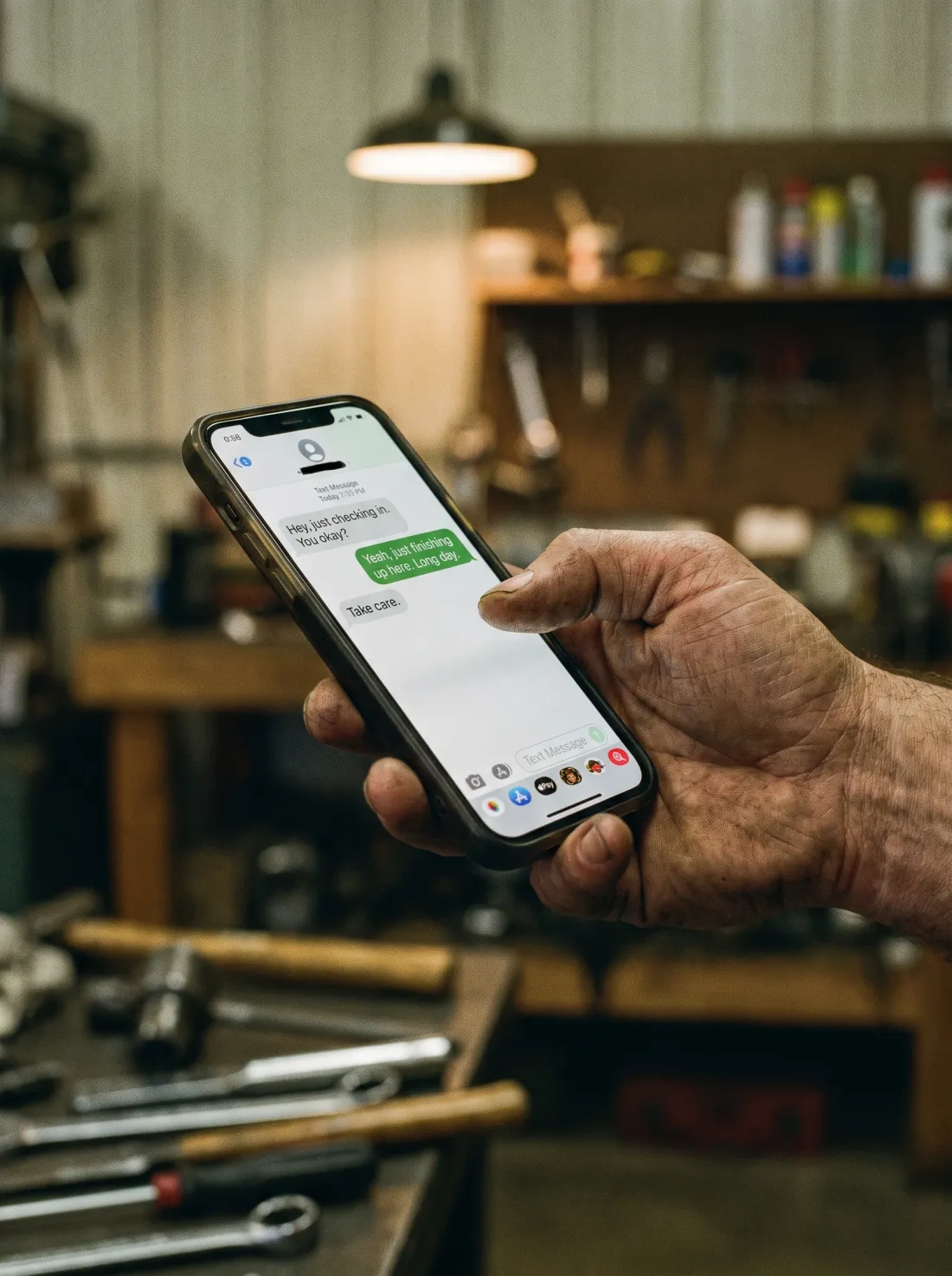
The point isn't to feel high-tech. It's that a missed call at 3pm gets a reply by text at 3:00pm and one second, not at 6pm when you finally check your phone — by which time the customer has already booked someone else. This runs by SMS, not a robot voice picking up your phone; the caller gets a real text message, and the conversation lands in your inbox for you to jump into whenever you're free.
Is this the same as the robots on building sites?
No — and it's worth being clear about the difference, because the word 'automation' gets used for both. A Perth-built bricklaying robot called Hadrian X can lay more than 1,000 bricks an hour and complete a house shell in two days, according to KAIZEN's 2026 construction trends analysis. That's automation at the physical, on-site end of the industry. What this page is about sits at the other end: software that handles calls, quotes, follow-ups and reviews in the office you don't have. You don't need a robot to get the benefit — you need the admin done without you doing it.
A worked example: the 3pm call
Picture a solo sparkie on a roof at 2:47pm on a Tuesday, halfway through terminating a switchboard, phone buzzing in his pocket. He can't answer it safely or practically. Without automation that call goes to voicemail, the caller hangs up before leaving a message, and by the time he's packed the van at 5:30pm he's forgotten it happened. With a missed-call text-back running, the caller gets an automatic text within seconds: 'Sorry we missed you — flat out on a job, what do you need help with?' More often than not the customer replies, because someone acknowledged them instead of leaving them on hold. That's the entire point of automation for tradies: not replacing the sparkie, just not losing the customer while he's up the ladder.
Where a trade business leaks time and money
Almost every trade business loses work in the same handful of moments. These are exactly the moments automation is built for.
- The call you couldn't answer because you were on the tools.
- The after-hours enquiry that sat unread until the morning.
- The quote you sent that went quiet and never got a follow-up.
- The happy customer who would have left a five-star review if anyone had asked.
- The hours lost each week to quoting, scheduling and invoicing paperwork.
Why the leaks matter more right now
Trade businesses have less slack to absorb these leaks than they did a few years ago. Master Builders Australia told the Senate Select Committee on Productivity in July 2026 that an unbalanced industrial relations environment is a significant contributor to the construction sector's poor productivity — in plain terms, it's harder and more expensive to simply hire your way out of an admin problem by putting another person on the phones. That makes plugging these leaks with automation, rather than headcount, a more realistic first move for a lot of trade businesses.
How the leaks compound
Each leak on its own looks small. A missed call, a quote that goes quiet, a review nobody asked for. But they stack: the missed call becomes a lost job, the lost job means less cash to hire help, and the lack of help means more calls get missed next week. Automation breaks that loop at the cheapest point — the response, not the labour.
Marketing, business, and admin automation — what's the difference?
People search for these as if they're different products, but they're three slices of the same pie.
Marketing automation for tradies is about demand — automatically staying in front of past customers and turning searches into enquiries, through review growth, Google presence, and follow-up sequences.
Business automation for tradies is the broadest term — the whole system that captures, qualifies, follows up and converts a lead end to end.
Admin automation is the back office — quoting, scheduling, invoicing, and after-hours call handling that takes paperwork off your plate.
You don't need all three at once. You need the one that plugs your biggest leak first.
Where staff rostering and job allocation automation fits
If your admin automation stretches into deciding who gets sent to which job — an algorithm allocating jobs to your techs based on location, skill or availability — that's now something NSW law treats as more than a scheduling tool. The Work Health and Safety Amendment (Digital Work Systems) Act 2026 defines a digital work system broadly enough to capture this kind of automated allocation, which matters if you run a multi-tech operation in NSW. More on that below.
Is automation for tradies regulated in Australia?
For most solo tradies and small crews, day-to-day automation like missed-call text-back and review requests is low-risk ground, though it is not unregulated: any commercial SMS you send, including a review request, still has to meet the Spam Act's consent, identification and unsubscribe rules. But if you employ staff and use software to allocate work, monitor performance or make decisions about rosters, NSW has just passed a law specifically about this.
What the NSW Digital Work Systems Act actually covers
In February 2026, NSW Parliament passed the Work Health and Safety Amendment (Digital Work Systems) Act 2026, amending the Work Health and Safety Act 2011 (NSW), according to OHS Reps. The Act defines a digital work system as an algorithm, AI, automation, or online platform used in the workplace, per an explainer from GoToCourt — a definition wide enough to cover a job-allocation app, a scheduling algorithm, or an automated performance dashboard, not just a chatbot.
What it means for a PCBU (you, as the business owner)
Once the operative provisions commence, a person conducting a business or undertaking will have to assess the risks that digital work systems introduce, including bias in automated decision-making and psychosocial harm such as unreasonable workloads, constant monitoring, and excessive performance pressure, according to PwC Australia's analysis of the changes. The amendments also introduce a duty to consider whether the way a digital work system allocates work could put a worker's health and safety at risk, per SafeWork NSW. Once those provisions commence, WHS entry permit holders will be able to require access to inspect a digital work system if they suspect it's contravening the Act, also per SafeWork NSW.
When it actually starts applying
None of this is live yet. The operative provisions only commence once the NSW Government announces a start date, and that date has to be at least one month after the Digital Work Systems Guidelines are published, according to SafeWork NSW. If you're a NSW trade employer using or planning to use automated job allocation or monitoring, it's worth knowing this is coming rather than being caught out once the guidelines land.
Where to start with automation
Start at the leak that costs you the most money, not the tool that looks the most impressive. For most tradies that's lead response — the missed call and the slow reply — because a lost job is worth far more than a saved hour of admin.
Fix speed-to-lead first: automatic text-back on missed calls and 24/7 qualification. Then layer on reviews, then follow-up, then admin. One strong step at a time beats a dashboard full of half-used apps.
A simple way to rank your leaks
Ask three questions about each leak: how often does it happen, what's the job worth if you win it, and how cheap is the fix. A missed call happens daily, a job is worth hundreds to thousands, and text-back is a low-cost fix — that's why it wins the queue every time. A slow quote follow-up happens weekly and the fix is nearly as cheap, so it's next. Review requests and admin paperwork matter, but they don't cost you a lost job the way a missed call does, so they come after.
How Freetide automates a trade business
Freetide builds the whole flywheel and runs it for you: a Demand Engine to get found, an Intake Engine that answers missed calls and qualifies leads by SMS around the clock, and a Reputation Engine that grows your Google reviews automatically. Bespoke to your trade, built in Melbourne, no lock-in contract.
The Intake Engine
This is the missed-call fix: when a call goes unanswered, the caller gets an automatic text back within seconds, and the conversation is qualified by SMS — not a voice bot, a text thread — so you get a name, a job type and urgency before you've even called back.
The Demand Engine
This is the marketing-automation slice — staying visible in local search and keeping past customers coming back with automated, honest follow-up sequences. We never advise fake, incentivised or gated reviews; genuine, ACCC-compliant review practices are the only kind worth having.
The Reputation Engine
This asks happy customers for a Google review automatically after a job's marked complete, so reviews build steadily instead of relying on you remembering to ask.