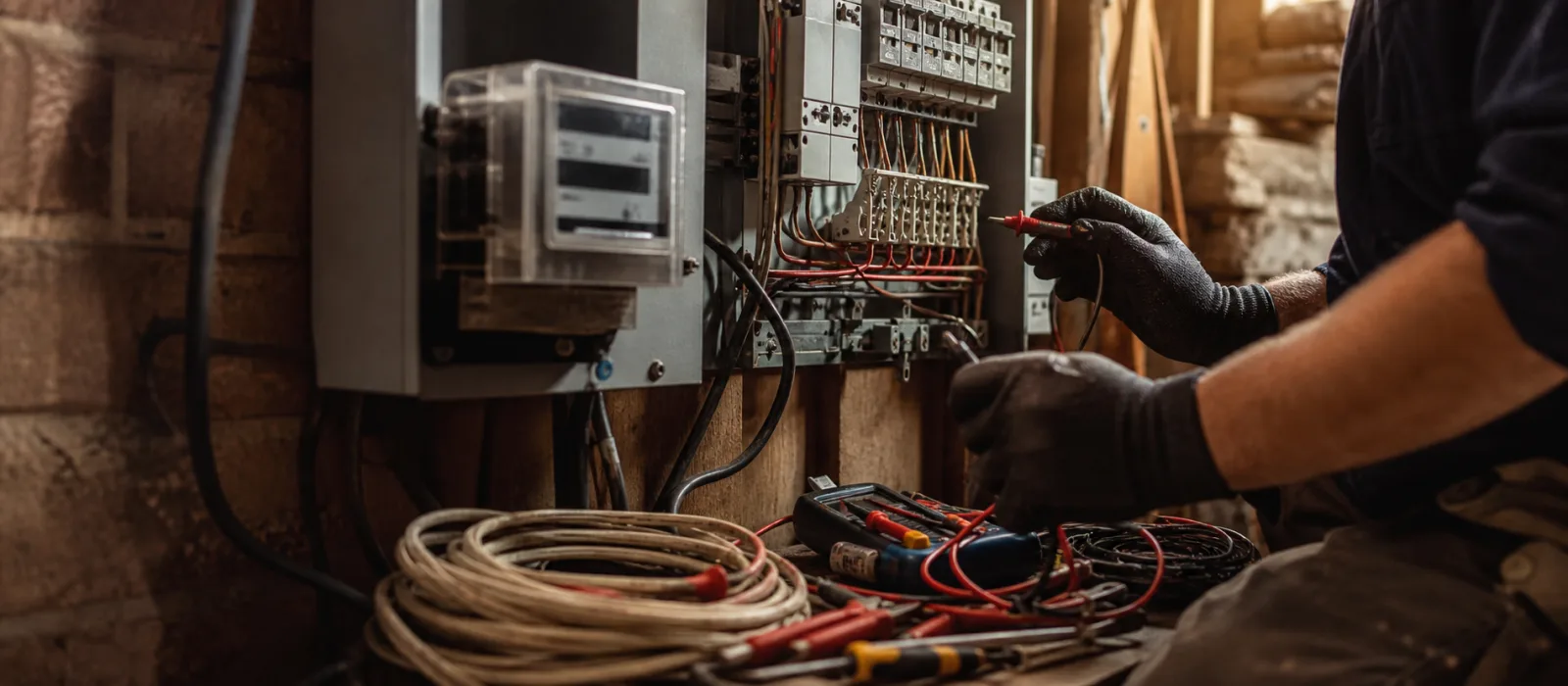
What is AI phone answering for electricians
AI phone answering for electricians is a system that responds the moment a call is missed, instead of leaving the caller to voicemail or nothing at all. For Freetide's build, that response is a text message sent within moments of the missed call, asking what the job is and where — not a synthetic voice picking up the phone.
The point isn't to replace you answering calls when you can. It's to catch the calls you can't get to — up a ladder, under a house, driving between jobs, or after 5pm when the next sparky's voicemail is the only other option the caller has.
- Sends a text within moments of a missed or unanswered call
- Asks what the job is, where it is, and how urgent it is
- Can book straight into your calendar or job software if you use one
- Runs after hours and on weekends without you touching your phone
Why not just use voicemail
Voicemail asks the caller to do all the work — leave a message, wait for a call back, hope you're free. Most people ringing an electrician have a live problem: no power, a tripped switchboard, a job they want quoted today. If voicemail is the only option, some of them ring the next name on the list before you've even picked up the message.
Why text instead of a voice bot
A text lands quietly and can be replied to from a work van, a site office, or between jobs, whereas a live voice bot demands the caller stop and talk to a machine there and then. It also lets the caller send a photo of the switchboard or the job straight back, which a voice call can't do.
Does AI phone answering mean a robot voice answers my calls
No. Freetide's version of AI phone answering for electricians works by text, not a synthetic voice. When a call goes unanswered, the caller doesn't hear a robot greeting — they get a text back within moments, worded like a real person from your business would send it.
This matters because a lot of people are wary of talking to an obviously automated voice about a live electrical fault, and it avoids the awkwardness of a bot mishearing a suburb name or a job description over a bad phone line.
What actually happens when someone calls
The phone rings as normal. If it's not picked up in your usual window, the call goes to voicemail as it always has, and at the same time the caller receives a text asking what they need help with. There's no interruption to your existing phone number or provider — the text-back runs alongside it.
What if the job is an emergency
The system is built to flag urgent language — no power, sparking, burning smell — so those replies can be pushed straight to you or whoever's on call, rather than sitting in a queue with a general enquiry about a power point.
How does text-back actually work on a real job
Picture an electrician running a business out of Dandenong. It's 10.40am and he's up in a roof cavity pulling new cable through for a switchboard upgrade. His phone buzzes in his back pocket — he can't get to it, and by the time he's back down the ladder the call's already gone to voicemail.
Within moments, the caller gets a text: sorry we missed your call, what's the job and where are you. The caller texts back that a kitchen power point keeps tripping and gives the suburb. The system asks a follow-up — is it urgent, and can they send a photo of the switchboard — then slots a tentative time into his calendar for that afternoon.
By lunchtime he's climbed down, seen the thread, confirmed the time, and driven straight there instead of scrolling missed calls and ringing numbers cold. The caller never had to leave a voicemail or try another electrician while waiting to hear back.
Is AI phone answering worth it for an electrician
It's worth it if missed calls are actually costing you jobs — which for most trade businesses running solo or with a small crew, they are. Every call that goes to voicemail while you're on the tools is a chance for the caller to ring someone else instead.
AI adoption among Australian businesses is still relatively young but growing fast. The Australian Bureau of Statistics reports that around 12% of Australian businesses used AI in 2024–25, while uptake among small and micro businesses was lower, at around 11%. That was a sharp acceleration on the very low rates the ABS recorded in 2021–22, before generative AI tools such as ChatGPT were available. Electricians and other trades sit in that smaller group — this isn't a gimmick reserved for big companies anymore, but it's also not yet the default.
Who it suits
It suits electricians who run their own bookings, have a small office, or simply spend most of the day with their hands full — anyone where a missed call has a real chance of becoming a lost job rather than a five-minute delay.
Who it doesn't suit
If you've already got a dedicated receptionist answering every call live during business hours, a text-back system adds the least value there — though it can still cover you after hours and on jobs that run late.
How much does AI phone answering cost for an electrician
There's no fixed industry price for this, and any number quoted without knowing your call volume, trade software, and after-hours needs isn't a real quote. Freetide scopes each build around what a business actually needs — how many missed calls a week, what job software you already run, whether you want coverage just after-hours or all the time — rather than selling a flat monthly fee for something that doesn't fit. The only honest way to get a real figure is a free audit of your current call handling.
Is AI phone answering compliant with Australian privacy law
It depends on whether the Privacy Act actually applies to your business — and if it does, the system has to be set up properly. Any AI phone answering service that collects a caller's name, number, address or job details is handling personal information. Where the Privacy Act 1988 (Cth) applies to your business, that handling brings it under the Privacy Act 1988 (Cth) and the Australian Privacy Principles, according to the Office of the Australian Information Commissioner — though many small businesses fall outside the Act's coverage unless a specific exception applies, such as opting in voluntarily, being a health service provider, or trading in personal information for a benefit.
The OAIC published specific guidance on AI privacy compliance in October 2024, making clear that businesses using commercially available AI tools need to check exactly how customer data is handled before switching one on. That guidance is worth reading whether or not you're confident the Act applies to you, because good data handling is good practice either way.
- Where is customer data actually stored
- Is Australian data residency available
- Are call or text transcripts used to train the AI model
What this means for your customers' texts
If a customer texts you their address and the fact their switchboard is sparking, that's personal information the moment it's captured — not sensitive information in the Act's narrower legal sense, which covers things like health or biometric data, but personal information all the same, and it deserves the same care regardless of which category it technically falls into. A properly built system should store it securely, use it only to book and manage that job, and not feed it into some unrelated AI model without you knowing.
Who's responsible if something goes wrong
If the Privacy Act applies to your business, that responsibility sits with you, not just the vendor. So if you're running an AI text-back under your electrical licence's name and the Act covers you, you're the one who has to answer for how that data's handled — which is why it's worth actually reading how a vendor stores and uses transcripts before you switch anything on, rather than assuming it's sorted.
Voicemail vs a receptionist vs AI text-back for electricians
Each option handles a missed call differently, and the right one depends on how you're currently losing jobs.
| Option | Speed of response | Ongoing cost | Where it falls short for electricians |
|---|---|---|---|
| Voicemail | Caller has to leave a message and wait for a call back | Usually free | Many callers hang up and ring the next sparky instead of leaving a message |
| Human receptionist | Fast, but only during rostered hours | Wage or contractor cost, every hour covered | Doesn't cover after-hours, weekends, or overlapping calls |
| AI voice bot | Instant, but it's a synthetic voice on the line | Varies by provider | Some callers hang up rather than talk to an obvious robot about a live fault |
| AI text-back (Freetide's build) | Text sent within moments of the missed call | Scoped per business in a free audit | Needs decent mobile signal both ends; not a fit if you already have full-time live coverage |
What job types can AI phone answering handle for electricians
It's built to sort urgent faults from routine work, not just log every call the same way. A tripped board or a smoke smell gets treated differently from someone asking for a quote on adding downlights.
The text-back can ask for a photo — of the switchboard, the meter box, or the job itself — so whoever picks it up afterwards knows roughly what's needed and whether the right gear is already on the truck, before a single phone call happens.
Service calls vs installation work
Service and fault calls usually need a faster response and less back-and-forth, so the system prioritises these. Installation and quote work can sit in a booking queue since there's less urgency, giving you time to call back properly.
Handling pricing questions by text
Rather than quoting a fixed price blind, the text-back can offer a rough range and explain that the exact price depends on what's found on site, which keeps expectations honest without under-quoting a job nobody's seen yet.
How does Freetide build AI phone answering for electricians
Freetide builds this as part of a bespoke lead-intake system, not a one-size-fits-all chatbot bolted onto your number. The build starts with mapping how your business actually gets calls — word of mouth, Google, referrals — and what a missed call currently costs you in lost jobs.
From there, the text-back is wired into whatever you already use to run your day — your calendar, or job software like Jobber or ServiceTitan if you run one — so a booking doesn't sit in a separate inbox you forget to check. It's tuned to your trade's job types, your usual pricing language, and your actual working hours, then tested and adjusted before it's left running unsupervised.
- Starts with an audit of how calls currently come in and get missed
- Text-back wording matched to how your business actually talks to customers
- Wired into your calendar or job management software where possible
- Set up to flag genuine emergencies separately from routine enquiries
What you get instead of a call sheet
Instead of a list of missed numbers to work through at the end of the day, you get a running thread of what each caller needs, already sorted by urgency, with the tyre-kickers and the tripped switchboard easy to tell apart before you've dialled anyone back.
How it gets tested before it runs unsupervised
Before it's left to run on its own, the wording and flow get checked against real scenarios from your trade — a tripped board, a quote request, a job at an address the system hasn't seen before — so the first genuine customer isn't the first test. Adjustments happen on the language and the urgency flags, not on your phone number or how calls come in.